HPA Systems & Transport Canada
Compressed air tanks and the Transport Canada rules.
By Hughie “mrhooie” Graham
The Great TC# Debate
It all started about June 2003, the Great TC# Debate. All of a sudden, Paintball Message Forums were in heated debates over what the Transport Canada (TC) regulations were for air systems. Well, first we must really get down to what the TC # is.
TC stands for Transport Canada. This is a Government of Canada run regulatory body that, in a nutshell, sets rules and standards for how stuff is transported in Canada. This includes CO2 tanks and High Pressure Tanks (HPA) for use in Paintball.
TC#s are gained by a manufacturer (the big ones being Carleton and Luxfer) who makes HPA and/or CO2 tanks. A batch of tanks is submitted to Transport Canada and TC will randomly select tanks and put them through a variety of tests. When a batch of tanks passes these tests, they are allowed to put a Transport Canada number on their manufacturing label. A clear coating to further protect the label and integrity of the tank then covers this label.
Testing
Some of the TC tests include:
Dropping a tank from a height of 3m onto a concrete surface three times:
Vertically onto the end; and
Horizontally onto the sidewall; and
Horizontally onto a 3.8 cm by 0.5 cm piece of angle iron, with the included angle in the downward position. The cylinder lands at right angles to and on the heel edge of the angle iron, impacting approximately at the centre of the sidewall.
A burst test is performed on cylinders that include bursting to destruction and cycle testing that includes filling the tank 3.06 times its operating pressure. If a tank doesn’t survive these tests, a few others from the batch are tested to ensure the integrity of the batch of tanks. If more tanks fail - the batch of tanks does not pass and is not allowed to display a TC permit number.
All of these extensive tests are to protect users of the HPA tanks from harm.
Re-qualification
Now, these tanks must be re-qualified every so often to make sure that they are safe to use. A tank that is manufactured before January 2003 must be tested 3 years from the manufacturing date (specified as 03A02 - this would mean the tank must be re-qualified before March 2005). Tanks are made so well that after the first re-qualification period, it is then due to be re-qualified 5 years from the date. Now a tank made after January 2003 must be re-qualified every 5 years.
The viability of the tank structure itself must be tested. This involves a special test in which the tank is over pressurized with water to determine its elasticity. If it passes, then there is a stamp placed on the neck of the tank, indicating a new hydro test date. For obvious reasons, a visual test is done before a hydro.
Total failures by all types of cylinder construction during hydrostatic re-test are only 0.65% (so you should have nothing to worry about if you are due for inspection).
A great page to check out pictures of hydrostatic testing is located here - http://www.sounddive.com/hydrotest2l.html
Filling Tanks as per TC Regulations
Now the law states that you cannot have a tank filled in Canada without a TC# on the label. If you go to a paintball field, the person filling the tank must do a visual inspection of your tank, which includes verifying there’s a TC# present and that the tank is within its hydro date.
Example Label
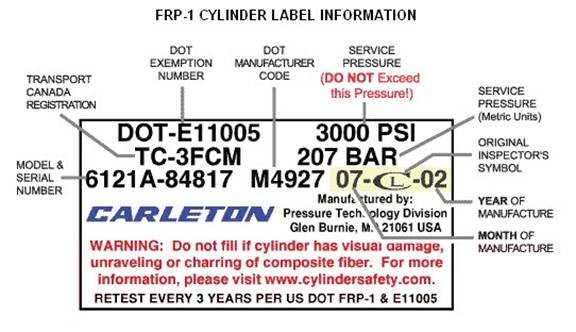
You can NOT have a tank tested in Canada with out a TC#. In fact, it’s illegal for a business to transport a tank without TC #.
Transport Canada writes in a personal exemption for end users in Canada. TC states that if the end user is filling their own tank from their own equipment, then the need for a TC# and valid hydro date is null and void. Why do they do this? I’m not quite sure, but it is written into their legislation
**Why the big furor over Transport Canada
’s?**
My theory is this. Someone tried to get a tank hydro tested at a facility and was told that it could not be done because their HPA tank did not have a required TC#. The maximum fine for not following Transport Canada guidelines is $10,000.
Why were companies allowed to sell tanks in Canada without TC#s? Again, a lack of knowledge, enforcement and a lack of tanks 4 years ago were all contributing factors to a lack of awareness. Some companies have stepped up to the plate and are exchanging tanks for Canadian players.
My advice? If you have a tank with no TC# on it and you play at paintball fields where the owner follows TC’s regulations, contact the business that sold you the tank. If they can’t help you out, phone or write the company that chose not to have tanks tested by TC. Phone, write - don’t just email. As a consumer, demand satisfaction in mature, appropriate way.
About the author:
Hughie started playing Paintball in 1999 at the Yellowknife Sand Pits with his roommates. The following summer Hughie opened a proshop “Splat Entertainment”.
Because quality goods were hard to find and it allowed him and his established group to find more people to play with. In November of 2001, Hughie formed the Paintball team “eXposure”. In the spring of 2003, Hughie partnered with long time Paintball player Lee Gauthier and formed the only Paintball Series in Northern Canada – “PolarBall”. An avid enthusiast of the sport of Paintball, Hughie continues to learn about and make friends and acquaintances throughout Canada and the US.